A kernel syscall was killing our Android app on x86_64
The app worked on ARM, worked on x86, and crashed instantly on x86_64 emulators. Three months to find two Go libraries making raw epoll_wait calls that Android's seccomp filter blocked.
Our end-to-end tests stopped working. The test APK wouldn't install on the emulators SauceLabs provides, because those emulators run x86_64 and we were only building for ARM and x86. Simple enough to fix: add x86_64 to the ABI list. Except that when we did, the app crashed two seconds after launch.
Not a JavaScript crash. Not a React Native red screen. A kernel-level SIGSYS signal that killed the process instantly. No stack trace, no error dialog, just gone.
This rabbit hole took three months.
The symptom#
Issue #17265 started as a QA report: e2e APK can't be installed on Android 12+ emulators. The fix seemed obvious: build for x86_64. A colleague created PR #17335 to add the architecture. The APK installed. Then it crashed immediately after the user created a profile and set a password.
Logcat showed:
Fatal signal 31 (SIGSYS), code 1 (SYS_SECCOMP), syscall 232
in tid 6327 (create_react_co)
SIGSYS with SYS_SECCOMP. The kernel's seccomp filter had blocked a system call and killed the process. Syscall 232 on x86_64 is epoll_wait.
The app was being killed by the Android kernel for calling epoll_wait. On ARM devices and x86 emulators, this same code worked perfectly. Only x86_64 emulators running Android 11+ triggered the crash.
Ruling things out#
I reproduced it locally with ANDROID_ABI_INCLUDE=x86_64 make run-android and started eliminating suspects.
First I tried relaxing SELinux with adb shell setenforce 0. No effect. Seccomp filtering is separate from SELinux and can't be disabled on non-rooted emulators.
I checked if the Flipper debugging library was the cause, since they'd had a similar SIGSYS crash on x86_64. It wasn't. Our crash happened with Flipper completely removed.
I suspected react-native-reanimated, okhttp, anything that might use native code differently on x86_64. None of them were the problem.
Following the crash#
The crash always happened 1-2 seconds after the "Generating Keys" screen appeared. I traced the call flow from the moment the user presses "confirm password":
- React Native dispatches a re-frame event
- ClojureScript calls into a native module
StatusModule.javacallscreateAccountAndLogin- This calls into
status-go, our Go backend compiled for Android via gomobile
I started commenting out code. When I removed the call to createAccountAndLogin, the crash disappeared. The problem was in the Go backend.
Into status-go#
I narrowed it down to g.store(childAccount, password) in account/generator/generator.go. Added logging around every function call. Everything looked correct. The arguments were valid, the account object was properly initialized, the password was a normal string.
The crash was deeper than the application code. Something in the Go runtime or one of our Go dependencies was making a system call that Android's seccomp filter didn't allow on x86_64.
The breakthrough#
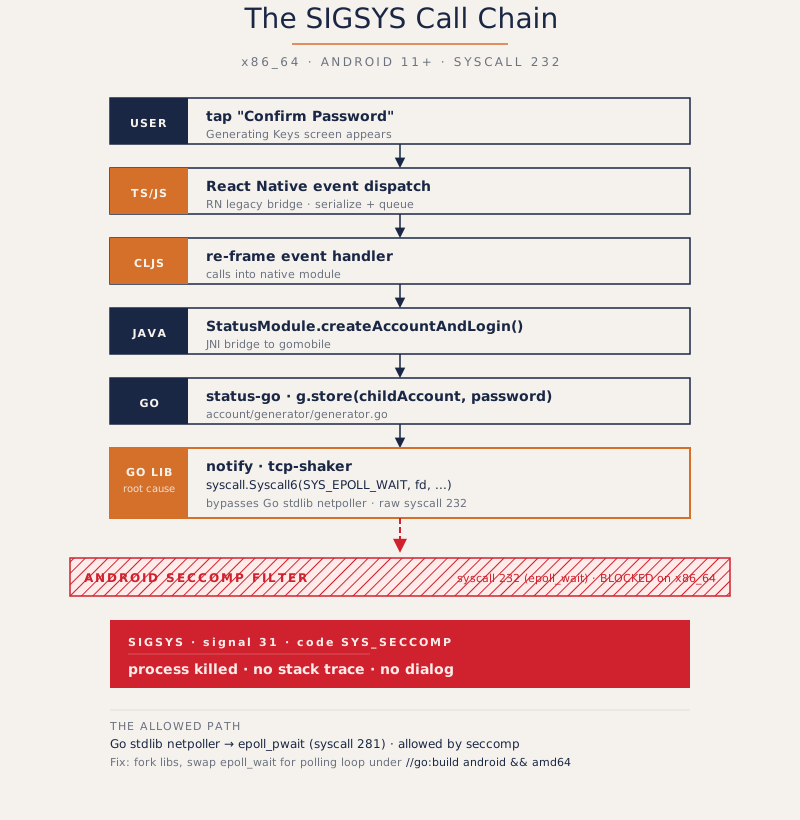
A colleague, bitgamma, pointed me to the key insight: syscall 232 on x86_64 Linux is epoll_wait. The Go standard library uses epoll for I/O multiplexing on Linux. But Android's seccomp policy, which got stricter starting with Android 11, blocks certain legacy syscalls on x86_64. epoll_wait is one of them. The "correct" syscall is epoll_pwait (syscall 281), which is what modern versions of the Go runtime use. But not all Go libraries go through the standard library's syscall wrappers. Some make raw syscalls directly.
I searched our dependency tree for direct uses of epoll_wait and found two:
github.com/rjeczalik/notify-- a filesystem notification library that used inotify with a rawepoll_waitevent loopgithub.com/status-im/tcp-shaker-- a TCP health check library that usedepoll_waitto poll socket events
Both libraries called epoll_wait directly through syscall.Syscall6 instead of using the Go standard library's netpoller, which had long since been updated to use epoll_pwait.
The dead end#
Before finding the real fix, I tried upgrading the Android NDK to r26. Google had fixed a similar seccomp issue in newer NDK versions. But status-go depends on go-sqlcipher, which uses CGo to compile OpenSSL. The AES assembly routines wouldn't compile with NDK r26's updated clang. NDK r25 compiled but didn't fix the crash.
The NDK wasn't the problem. The problem was raw syscalls in Go libraries that bypassed the standard library.
The fix#
I forked both libraries and created platform-specific implementations for android && amd64:
For tcp-shaker (status-go PR #4233): replaced the epoll_wait event loop with a polling loop that uses unix.Recvfrom with MSG_DONTWAIT|MSG_PEEK and a 10ms sleep interval. Not as efficient, but it doesn't call any blocked syscalls.
For notify: rewrote the inotify event loop to use direct unix.Read calls on the inotify file descriptor and a signal pipe, with separate goroutines for each, instead of multiplexing with epoll_wait.
Both changes used Go build tags so the original implementations are preserved on all other platforms:
//go:build android && amd64The original files got the inverse tag:
//go:build linux && !(android && amd64)I also modified the mailserver ping logic to skip TCP health checks entirely on Android emulators, since the polling fallback was less reliable than the epoll-based version and mailserver selection doesn't matter in test environments.
The final PR in status-mobile was anticlimactic: 6 files changed, 6 additions, 6 deletions. Point to the fixed status-go, add x86_64 to the ABI list, bump the Jenkins library version.
The takeaway#
The crash existed because two Go libraries made raw epoll_wait syscalls that Android's seccomp filter blocks on x86_64. On ARM and x86, the same syscall number maps to a different (allowed) call, or the seccomp policy is more permissive. The bug only appeared on x86_64 emulators running Android 11+, which is exactly the environment our CI used for end-to-end tests.
What made this hard wasn't the fix. The fix was straightforward once I knew which syscall was being blocked and which libraries were making it. What made it hard was the distance between the symptom ("app crashes after creating a profile") and the cause ("a filesystem notification library is calling a blocked kernel syscall on this specific CPU architecture"). That distance is three months of ruling things out, tracing call stacks through four languages (TypeScript, ClojureScript, Java, Go), and learning more about Android's seccomp policy than anyone should have to.
Support · Optional and appreciated
If something I've built or written saved you time, you can keep the lights on.