Migrating Android CI to Qt 6.9 with self-controlled Docker images
Why we stopped trusting upstream images and what it took to own the build environment entirely.
Before Jenkins-based Android builds existed at status-app, they ran on GitHub Actions inside a third-party Docker image pulled fresh every run. The migration off that setup, to our own Jenkins pipeline, our own Dockerfile, and eventually aqtinstall, took about six months and five PRs.
The starting point#
The pre-existing workflow was mobile/.github/workflows/android-build.yml, with this container declaration:
container:
  image: carlonluca/qt-dev:6.8.3
env:
  ANDROID_NDK_HOME: /opt/android-sdk/ndk/26.1.10909125
  QT_PATH: /opt/qt/6.8.3
  JAVA_HOME: /usr/lib/jvm/java-17-openjdk-amd64
carlonluca/qt-dev is a community Qt development image maintained by Luca Carlon. It's well-maintained and convenient. But convenience came with transitive trust: we were trusting whoever pushed that image to also pick the right base OS, the right bundled NDK, the right apt layers, and the right Qt compilation flags. The tag was pinned, but layers inside a tag are not. An image author can re-push :6.8.3 at any time without a changelog.
Moving to Jenkins + own Docker#
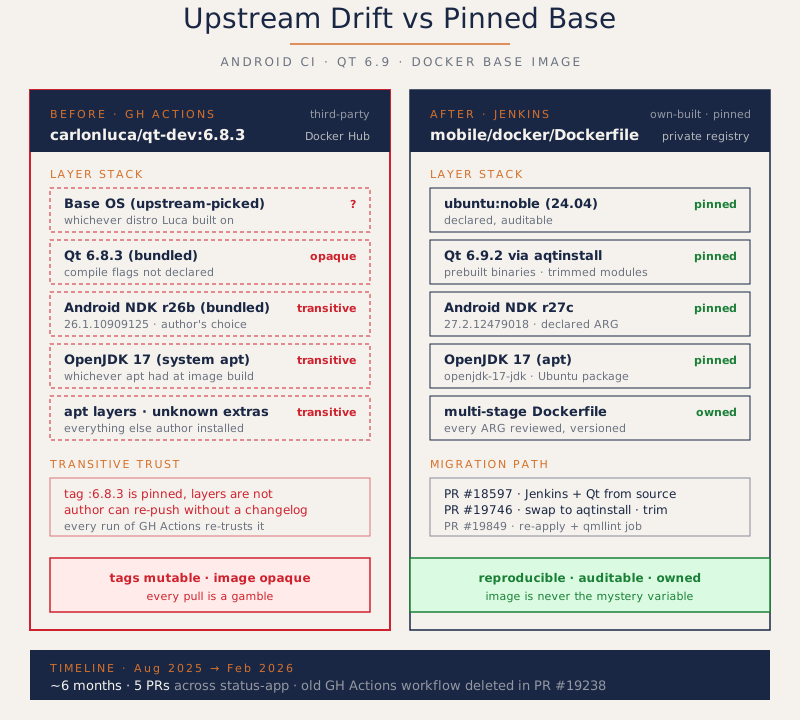
I opened PR #18488 as a draft in August 2025 to prove we could build PR Android APKs from our own Dockerfile. Two weeks later, PR #18597 merged the production setup: a Jenkins pipeline (ci/Jenkinsfile.android) plus a multi-stage Dockerfile under our control (mobile/docker/Dockerfile).
The pinned ARGs in that first version:
ubuntu:noble(24.04) as the base imageQTVER=6.9.0, built from source inside DockerANDROID_NDK_VERSION=27.2.12479018(r27c)JAVA_VERSION=17, installed viaapt-get install openjdk-17-jdk
Qt 6.9.0 got bumped to 6.9.2 shortly after in commit c0e81420. Every image rebuild was a separate manual Jenkins job because compiling Qt from source was slow enough that we didn't want it running on every PR.
The old GitHub Actions workflow stayed active in parallel for a few months, which in hindsight was a mistake. Parallel CI paths erode trust in which one is canonical. Developers never know which build is "the" build. I finally deleted it in PR #19238 in November 2025.
Simplifying with aqtinstall#
Compiling Qt from source turned out to be overkill. PR #19746 replaced the from-source compile with aqtinstall, a Python tool that downloads prebuilt Qt binaries by version. The PR description is exactly what the blog post would say:
- Switch from compiling QT ourselves to relying on
aqtinstall- uses fewer qt modules
- adds cleanup stage to save space
Dropping unused Qt modules was the real efficiency win. Cleaning up intermediate files inside the same RUN layer kept the final image small.
The first roll-out was too aggressive: it stripped QtQml.StateMachine, which some QML files depended on, and the app crashed at runtime with module "QtQml.StateMachine" is not installed. PR #19849 re-applied the simplification with the missing module restored, and added a qmllint CI job so this class of import failure gets caught before a build ships.
What I'd do differently#
Cut the old CI path on day one. The android-build.yml workflow kept running for months after Jenkins took over, and every run of it was quietly re-trusting choices we didn't own. The cost of deleting a CI path nobody is actively using is zero; the cost of leaving two paths alive is ambiguity that compounds.
Start with aqtinstall, not a from-source compile. Building Qt from source is a tempting default for maximum control, but prebuilt binaries are good enough for the vast majority of needs and save real build time. The only reason to compile from scratch is if you need a patch that isn't upstream. If you need that, you'll know.
Support · Optional and appreciated
If something I've built or written saved you time, you can keep the lights on.